

FAMILY DYNAMICS / GOVERNANCE
Fair does not ‘equal’ equal

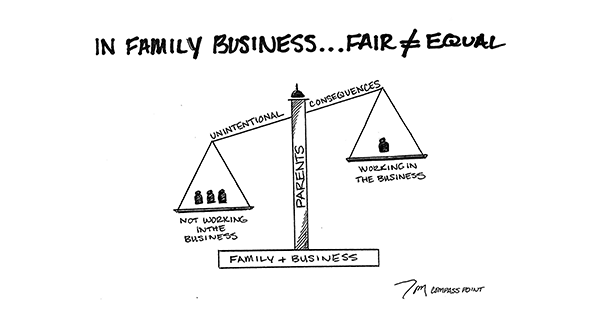
This is one of the biggest problems in family business governance, where parents are trying to be fair to the children, and they think being fair means being equal.
In a family business, fair does NOT mean equal. This well-intentioned misconception generally causes all sorts of problems and disharmony. It is the very thing the parents were trying to avoid in the first place, along with the confusion and financial implications that are sure to follow.
Let’s dive into the two most common situations that I often see:
Situation #1: Same pay for all
Scenario: Parents attempt to be fair by paying all siblings the same rate – regardless of what job the child has.
The Pitfall: When family business parents run with this concept of paying all the kids the same amount so “they won’t fight”, they are actually setting up the children for disharmony and conflict.
Advice: Let qualifications (not last name) be the deciding factor.
When there is good governance in place, a job description and a salary band are created. Regardless of whether people are inside or outside the company apply for the position, including family members, they should be evaluated on their ability to meet the established qualifications defined for that role. The interview process is followed by ALL candidates, and the best candidate is awarded the position.
Keep this in mind: All jobs are not equal. Not all effort is equal. Not all performance is equal. Do NOT pay your kids the same rate. It’s almost a guarantee to create anger, conflict, and disharmony. Pay according to the job market, pay according to experience, pay according to their performance – just like every other position in your business held by a non-family member.
More food for thought: If the family member is competent and qualified, AND they win out over all the candidates, they’re hired. Their compensation should also be within the agreed-upon salary band. If you want to pay family members additional monies outside of the compensation program that you have for your company, then do that with distributions.
Situation #2:
Scenario: Let’s assume the business owner has four children. In the estate planning process, the parents have set up their will to state that the business will be divided equally between the four siblings, or 25% each.
The Pitfall: While on the surface this seems fair and equitable it is anything but that. Why? Because in this scenario, only one of them works IN the business, but that one now has multiple partners.
Advice: Start planning with value in mind.
If you want to be fair with your kids around the business and the rest of your estate, here is a better solution: determine the value of the business. The child who works in the business gets that value in the form of the business. The other children are going to get that equal amount of value out of the liquidity of your estate first. And if there’s any estate liquidity left over after that balance has been met, then that remaining amount is divided equally by the four children.
Keep this in mind: When a business is sliced up equally among the surviving kids in the name of fairness, that means the one working his/her tail off, doing all the work, suddenly has three uninvited, probably unwanted partners, who, in most cases, know nothing about the business. This is a recipe for disaster. I can tell you from experience, that most businesses don’t survive that kind of transaction.
More food for thought: Think through the unintended consequences when you’re trying to be fair. Get advisors involved who can help you think through the possible ramifications down the road from your concept of being “fair and equal”.
And if a lot of your net wealth is tied up in the business, start working with a team of qualified advisors TODAY to work on building a game plan to unlock the wealth inside your business while you have plenty of runway to make smart, unemotional decisions.
Fair does not mean equal. And the proper Governance will ensure that your family and the business can avoid the inequality of well-intentioned fairness in a family business.
Besides, you started the business to create something bigger than yourself. Make sure you are creating a thriving legacy – and not a dysfunctional mess – for your family and heirs.
You may also like…

BLOG | FAMILY DYNAMICS / GOVERNANCE
The 4-Letter Word Owners Can’t Afford NOT to Talk About: EXIT
I’ve had my share of family business owners who avoid discussing this four-letter word to the point of pure denial, quickly ending the conversation when this word bubbles up. The word? E-X-I-T. It sounds so final. The brutal truth is that 100% of owners exit the business, yet only 50% – just 1 out of 2 owners – will do it on their terms...
Read More
BLOG | LEADERSHIP
Family Business Peer Groups are Gamechangers for the Next Gen
Many family-led companies hire business consultants to grow the business. Some even send their emerging leaders to personal development programs. But there is a gap – and it’s a BIG one.
Read More
BLOG | PEOPLE / TALENT
Unlocking the Golden 5% in Your Employees
The Golden 5% is the full expression of our ability, multiplied by our maximum possible effort, multiplied by our full contribution of heart. It is the performance equivalent of what we offer in a deeply loving relationship – the absolute best of ourselves. And yet, we rarely give it or reliably inspire the giving of it by others in organizations. Why?
Read MoreWhere Family Businesses Come to Grow & Learn
At Compass Point, we make it easy to get insights, training, tools, and articles straight to your inbox and help family business owners and their team continue to grow, learn, and lead.