

FAMILY DYNAMICS / GOVERNANCE
Talking Business with Tom Garrity: Responsible Ownership — The Job That Doesn’t Come With a Job Description

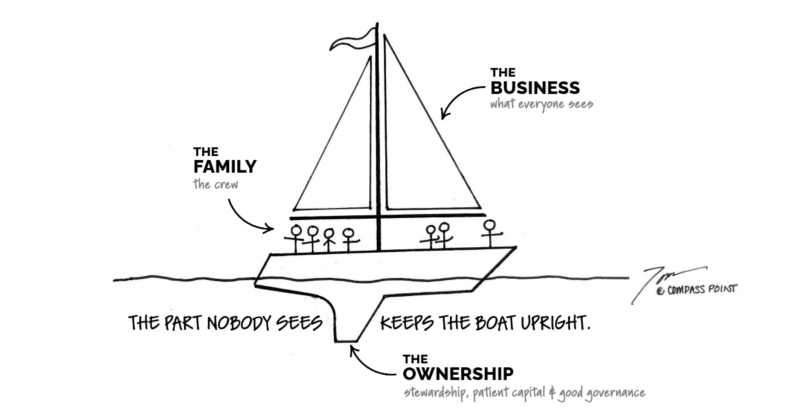
In my last column, I wrote about where the family fits in a family business, using the Three-Circle Model that shows every family business is really three systems overlapping: family, business and ownership. Most of us understand the family circle. We live it. Most business owners understand the business circle. They built it.
The ownership circle gets the least attention. It may matter the most.
Owning shares in a family business isn’t a reward. It’s a responsibility. Stock certificates don’t come with a job description, but they should. When owners don’t know their job, they tend to do one of two things: meddle in management or disappear entirely. Neither ends well.
Every good business has a strategy. Far fewer families have an owners’ strategy — a clear agreement about what the owners want from the enterprise. How much growth? How much risk? How much debt? What gets reinvested, and what gets distributed? Do we stay private forever, or are we open to selling someday? Can family members work in the business, and on what terms?
Those aren’t management questions. They’re ownership questions. When owners answer them, management can lead with confidence. When owners don’t, management guesses — and the family argues about it later.
The best owners I’ve worked with see themselves as stewards. They received something from a prior generation, and their job is to hand it off in better shape than they found it. Stewards ask, “What does this enterprise need?” before they ask, “What do I get?”
That long view is one of the great competitive advantages of family business: patient capital. Family owners can make a 10-year investment while a public company worries about next quarter. They can invest in people, facilities and relationships that pay off slowly. But patient capital only works when owners are aligned. A divided ownership group doesn’t think long term. It thinks about the next distribution check.
Most families invest in developing leaders for the business, and they should. But the other two circles need leaders too. The family needs leaders who can bring people together, facilitate hard conversations and keep the family connected to its purpose. The ownership group needs leaders who can read financial statements, hold a board accountable and represent all shareholders — not just their own branch.
These aren’t always the same people. The best operator in the family may not be the best family council chair. That’s healthy.
This is where next-generation development gets serious. Your children may never run the business. But if they’re going to own it, they need to learn how to be good owners — long before they inherit a single share. Responsible owners protect the business from the family’s worst instincts. That means insisting on the right person in the right seat — family or not.
Let’s be honest: nothing drives good non-family talent out the door faster than watching an unqualified relative get promoted because of a last name. And nothing hurts a family member more than being placed in a role they can’t succeed in. Merit protects everyone.
Families often treat succession and ownership transition as one event. They’re not. Leadership succession answers, “Who will run the business?” Ownership transition answers, “Who will own it, and how?” The best CEO may not be the largest shareholder. Some owners will work in the business; others won’t. Fair doesn’t always mean equal. Both take years, not months – and both go better when the family can talk about them openly.
That brings me back to where every one of these columns seems to land: the family. Responsible ownership requires a family that can discuss money, performance, compensation, dividends and succession without it turning personal. Those are crucial conversations – high stakes, strong opinions, big emotions…where the outcome matters. Families that avoid them don’t avoid conflict. They postpone it, with interest. Unity doesn’t mean agreement. It means commitment to the bigger picture, even when you disagree on the details.
Good intentions need structure. That’s where governance comes in. Governance is just a fancy word for how decisions get made and where. Governance isn’t bureaucracy. It’s how a family turns its values into decisions. It’s having the right conversation in the right circle.
For the Ownership Circle, that means a real board with independent directors. A shareholder agreement that settles buy-sell terms and valuation before anyone needs them. Regular owner meetings where owners are informed, not surprised. For the Family Circle, it means a family council and family constitution that define how the family participates. For the Business Circle it means an executive team who build and execute the strategic plan that achieves the goals and vision of the owners, and run the day to day.
Good governance doesn’t eliminate disagreement. It gives disagreement somewhere productive to go. Most family conflict isn’t bad people. It’s someone applying rules of one circle to a decision that belongs in another. “He’s my son, so he should run the plant”, is a family rule applied to a business decision.
Ownership is the circle that holds the other two together. Get it right, and the family has a reason to stay united and the business has the patient capital to grow. Get it wrong, and even a great business can come apart.
You don’t just inherit a family business. You inherit responsibility for what happens next.

You may also like…

BLOG | LEADERSHIP
Who Should Bale the Hay?
Baling hay. It’s important & urgent work on a farm. It’s also a great business metaphor related to THE NUMBER ONE barrier to growth...
Read More
CLIENT STORIES
Building a business that gave this owner his time – and family – back.
The owner was the business – sales, customer service, operations, finance, and team building. See how Compass Point helped the owner build out a team that could both build custom homes and high-end remodeling.
Read More
BLOG | STRATEGY
Life mimics business. Business mimics life.
There seems to be a false notion floating around – and we all buy into – that somehow we're going to get everything in order tomorrow...
Read MoreWhere Family Businesses Come to Grow & Learn
At Compass Point, we make it easy to get insights, training, tools, and articles straight to your inbox and help family business owners and their team continue to grow, learn, and lead.