

Tom Garrity

BLOG | FAMILY DYNAMICS / GOVERNANCE
Talking Business with Tom Garrity: Responsible Ownership — The Job That Doesn’t Come With a Job Description
Responsible ownership is about more than holding shares in a family business – it’s about understanding the responsibility of preserving, guiding and strengthening the enterprise for future generations. Tom Garrity explores how clear ownership strategies, family alignment and strong governance help family businesses navigate succession, make better decisions and build a lasting legacy.
Read Post
BLOG | FAMILY DYNAMICS / GOVERNANCE
Talking Business with Tom Garrity: Where Does the Family Fit in a Family Business?
More than 40 years ago, one of the most useful ways of understanding family enterprise was created – The 3 Circle Model. Every person in a family enterprise occupies one or more of those circles. Each sees the enterprise from a different seat. The problem starts when families pretend the differences don’t exist.
Read Post
BLOG | TRANSITION / SUCCESSION
The Real Work Starts Before Succession: Raise Adults, Not Children
One of the most important jobs parents have is also one of the easiest to misunderstand. Our goal isn’t simply to raise children. Our goal is to raise capable, responsible adults. For family business owners, that distinction is especially important.
Read Post
BLOG | FAMILY DYNAMICS / GOVERNANCE
What Actually Holds a Family Business Together Across Generations?
Family businesses rarely struggle because of strategy alone—they struggle when there is no shared purpose strong enough to unite generations. Long-term continuity depends on more than ownership, succession plans, or governance; it requires a clear reason for the family to work, lead, and build together.
Read Post
BLOG | FAMILY DYNAMICS / GOVERNANCE
Talking Business with Tom Garrity: When the Past Shows Up and What Strong Families Do About It
Family business challenges rarely start with strategy—they often stem from inherited patterns of communication, conflict, and identity that have shaped the family for generations. The good news is that while these patterns are powerful, families that intentionally build awareness, resilience, and better governance can break the cycle and prepare the next generation to lead differently.
Read Post
BLOG | FAMILY DYNAMICS / GOVERNANCE
Talking Business with Tom Garrity: The Next Generation’s Dilemma
If you want your Next Gen in the family business, read how to make it a place where capable adults can lead, grow and be trusted. Otherwise, they’ll blaze their own trail – and they won’t be wrong to do so.
Read Post
BLOG | TRANSITION / SUCCESSION
Talking Business with Tom: Avoiding Next-Generation Stall-Out
Thousands of family businesses will change hands in the coming decade. Some will thrive across generations. Others will stall quietly, then disappear. The difference won’t be luck. It will be preparation.
Read Post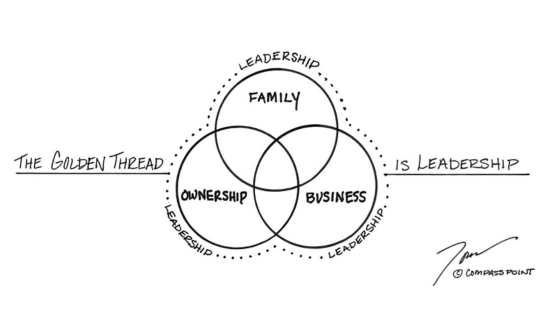
BLOG | LEADERSHIP
The Golden Thread that Binds Family, Business, and Ownership
The most successful family businesses don’t leave leadership development to chance. They recognize that leadership isn’t just about a single person at the top – it’s about building a system that supports leadership at every level – and through each of the 3 domains of a family business. It truly IS the golden thread that binds.
Read Post
BLOG | EXECUTION
Hitting a Wall in Business: Which Blocks are in Your Wall?
A management team had hit “that wall”. Sales were stagnant and communication was at an all-time low. The team dreaded meetings and they weren’t sure how to move forward. Learn how the owner transformed his stagnant company with the help of a new CFO and consulting support, resulting in a significant profit increase and revitalized team dynamics.
Read Post
BLOG | FAMILY DYNAMICS / GOVERNANCE
The 4-Letter Word Owners Can’t Afford NOT to Talk About: EXIT
I’ve had my share of family business owners who avoid discussing this four-letter word to the point of pure denial, quickly ending the conversation when this word bubbles up. The word? E-X-I-T. It sounds so final. The brutal truth is that 100% of owners exit the business, yet only 50% – just 1 out of 2 owners – will do it on their terms...
Read Post
BLOG | FAMILY DYNAMICS / GOVERNANCE
Business Issues: Identify and solve, or they could cost you.
Part of the challenge in a family business, or any business for that matter, is that the world does not stop and allow you to pursue your strategy in a nice, orderly fashion. Whether it is internal or external, business issues pop up throughout the day. So how do you prevent issues from derailing the company’s progress? Here are a few ideas for minimizing their occurrence and how to deal with them effectively when they do happen.
Read Post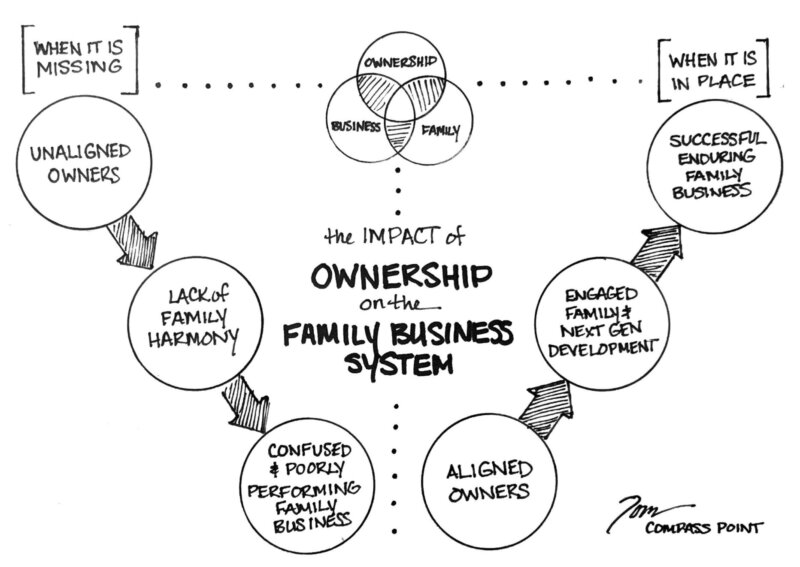
BLOG | FAMILY DYNAMICS / GOVERNANCE
The Many Facets of Ownership
In 1978 the 2-circle illustration of family business evolved when Harvard business professor Renato Tagiuri and then-graduate student John Davis added a third circle – Ownership – to better account for the distinct groups that existed in a family business. With the addition of Ownership, the 3-circle model more accurately captured the seven facets of ownership.
Read PostWhere Family Businesses Come to Grow & Learn
At Compass Point, we make it easy to get insights, training, tools, and articles straight to your inbox and help family business owners and their team continue to grow, learn, and lead.