

LEGACY / COMMUNITY
Planning for the Unexpected is a Generous Act


A question to consider:
If something happened to you tomorrow, could the people who love you find what they’d need?
Years ago, I sat at my mother’s kitchen table while she was sick and undergoing chemotherapy, and we went through everything. Account numbers, passwords, where the important documents were kept, who to call and in what order. It wasn’t an easy afternoon, but it gave me something to hold onto in a time that felt completely out of my control. I was lucky; she was still able to walk me through it, and we did it together, in real time.
Not everyone gets that chance.
This year I’ve watched friends and family lose people suddenly, to illness, to unexpected health issues, to accidents. Some of them had a plan. Many didn’t. And the difference has been stark. The ones with a plan grieved. The ones without one grieved, and then spent the next year untangling a mess nobody meant to leave behind.
This isn’t just a personal issue. It’s a business one, too.
If you lead or own a business, ask yourself:
- Does anyone besides you know where the important documents live?
- Who has the authority to make decisions if you can’t?
- Does your plan actually exist somewhere, or only in your head?
Planning for the unexpected isn’t pessimism. It’s one of the most generous things you can do for the people who depend on you, at home and at work.
What my mother and I did at her kitchen table was informal; two people, a notepad, and whatever time we had left. It worked because she was still well enough to walk me through it. Most families don’t get that chance, and good intentions written on a notepad aren’t a plan.
A few tools make that same conversation formal and lasting, so it doesn’t depend on someone being well enough, or having enough time, to have it:
- An emergency management plan. A simple, living document with account numbers, passwords, key contacts, and clear instructions, for your family and your business, kept somewhere the right people can actually find it.
- A buy/sell agreement. For business partners, this spells out what happens to ownership if someone dies, becomes incapacitated, or wants out, so the business isn’t left guessing.
- A trust. Protects family assets, keeps decisions out of probate court, and spares the people you love from piecing everything together after the fact.
None of these do any good sitting unwritten, and I know all three can feel overwhelming and complex. The easiest way to start is with one small step.
Come to our workshop, Part I, Understanding Trusts on October 6 or Part II, Strategies in Action on October 20. Listen to a podcast on the topic. Talk to your advisor. Talk to your parent, your sibling, whoever needs to be part of the conversation.
Just please, don’t do nothing.

You may also like…
BLOG | FAMILY DYNAMICS / GOVERNANCE
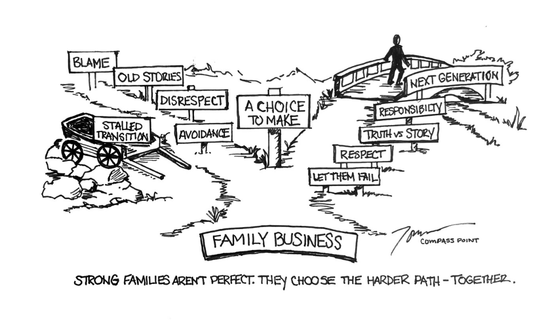
Talking Business with Tom Garrity: When the Past Shows Up and What Strong Families Do About It
Family business challenges rarely start with strategy—they often stem from inherited patterns of communication, conflict, and identity that have shaped the family for generations. The good news is that while these patterns are powerful, families that intentionally build awareness, resilience, and better governance can break the cycle and prepare the next generation to lead differently.
Read More

BLOG | TRANSITION / SUCCESSION
How to FAIL at succession planning in 3 easy steps…
While I love reading articles like “the top 10 ways to….” or “how to succeed in business without really trying”, sometimes I’m more curious about how to avoid...
Read MoreWhere Family Businesses Come to Grow & Learn
At Compass Point, we make it easy to get insights, training, tools, and articles straight to your inbox and help family business owners and their team continue to grow, learn, and lead.